Fear gives it weight. Witness gives it edges. What stands between those conditions is the only place a blade may reach it.
General Account
The Unbound is neither an animal nor a spirit in any conventional sense. It does not breed, build lairs, defend territory, or kill for meat. It is a consequence of the Ancestral Fracture that has acquired appetite, memory, and intent.
When the Third Council sought to bind the authority of Axios into the world without the answering gift of Charis, the resulting break did more than open Falamh. It created a gap between the laws by which things are measured and the grace by which they remain joined. Within that gap, stone forgot its shape, mortar surrendered its bond, names loosened from memory, and promises ceased to feel necessary.
The Unbound is believed to have emerged from that failure.
Most scholars speak of it as a single being. Others argue that each manifestation is a separate growth produced wherever the Fracture becomes sufficiently severe. No account has proven either belief. Sightings separated by hundreds of miles have displayed knowledge that should not have traveled between them, suggesting either one intelligence moving through many wounds or many creatures sharing the same inherited memory.
For this reason, experienced Cartographers advise against referring to “an Unbound.” The definite title is retained deliberately.
Lesser Appearance
Old field reports describe the Unbound as a person-shaped absence: a hollow in the air around which light bends incorrectly. This description remains accurate, but it does not represent the creature’s complete anatomy.
The humanoid outline is a hunting projection. A solitary observer expects danger to possess a recognizable shape, and the Unbound uses that expectation. It attaches itself most readily to the first person who notices it, allowing the victim’s mind to supply the crude dimensions of shoulders, limbs, and head.
It possesses none of these features in that state.
The projected form moves without footfall and casts no reliable shadow. Flames lean away from it. Dogs whine or press themselves flat against the ground. Voices become difficult to locate. The marked observer begins hearing thoughts that seem to arise from within:
You do not have to remain.You owe them nothing.Make the gift a debt.Stand alone and nothing can be taken from you.
While the victim struggles against these suggestions, the physical world around them begins to loosen. Bootlaces untie. Sword belts slacken. Healed wounds split. Door hinges release their pins. Companions forget why they trusted one another.
If resisted, this lesser form may withdraw. If sufficiently fed, it gathers.
The Gathered Form
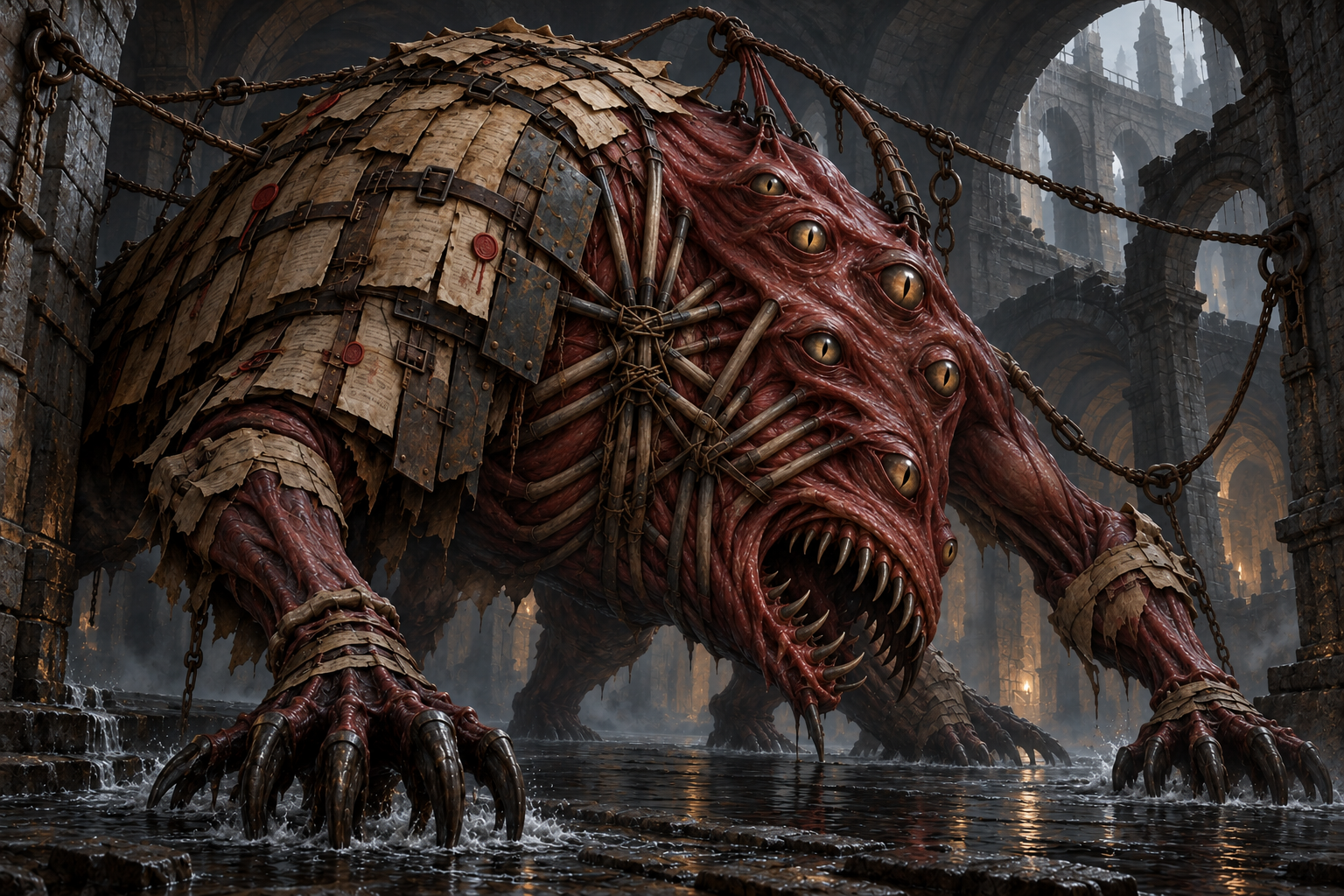
The manifestation depicted in the Cael Ortha plate is the largest confirmed embodiment of the Unbound. Witnesses estimated it to stand between four and five times the height of a grown person at its highest shoulder, with a breadth sufficient to obstruct a gatehouse passage. Exact measurements are unreliable; its dimensions alter according to the material, fear, and structural cohesion available to it.
Unlike its lesser projection, the Gathered Form has tremendous physical weight. It does not float. It plants its long forelimbs into the earth and drags the rest of its mass forward in violent, uneven heaves. Stone cracks beneath its claws, pooled water surges around its legs, and its armored side scrapes walls like an overturned siege engine.
Its body is divided into two visibly different structures.
The Armored Hemisphere
One side of the creature is protected by a swollen, domed carapace assembled from layered paper, hide, thin metal, wire, leather straps, seals, buckles, and splintered boards. Ledger pages overlap like scales. Ration slips adhere beneath iron bands. Official seals remain visible even after the words surrounding them have bled into illegibility.
These objects are not ornaments. Every piece once served to identify, fasten, certify, restrain, or claim something.
The armor is unnaturally orderly. Its plates lie in measured rows, its straps cross at deliberate intervals, and its fasteners appear calculated to distribute the creature’s enormous weight. This half resembles Axios stripped of judgment and made monstrous: structure preserved after all reason for preservation has been forgotten.
Paper is not the Unbound’s natural flesh. It is scaffolding.
Where a government reduces people to entries, where ownership replaces belonging, or where law is used to make cruelty appear clean, the Unbound gains an abundance of shapes it can imitate. In Cael Ortha, Crown notices gave it a hide, requisition orders gave it plates, and execution records taught it the forms of hooks, chains, nooses, and authority.
The Exposed Hemisphere
The opposite side remains raw and unfinished.
Ribs of blackened cartilage rise beneath a web of wet, reddish tissue. Tendons cross one another without following any natural skeleton. Muscle clings to paper, wire, and bone indiscriminately, as though the creature understands that a body requires connective tissue but not where that tissue properly belongs.
The flesh is warm and visibly vascular, yet no heartbeat has been heard within it. When wounded, it releases a thin, dark fluid mixed with paper fibers and grit. The substance smells of iron, wet vellum, and old cellar water.
This half is not wounded. It was assembled incomplete.
The Seven Eyes
Seven eyes are distributed unevenly across the exposed flesh. None occupy a position that would suggest a face.
Each rests inside its own nest of tendon and scar tissue. Some are deeply recessed; others protrude far enough to tremble when the creature moves. Their lids close from mismatched directions, and their pupils narrow into irregular slits rather than circles. The eyes move independently, often watching several people or objects at once.
Witnesses report that the eyes do not merely follow bodies. One may remain fixed upon a wedding band, another upon a cord between companions, another upon a scar received while protecting someone else. The Unbound appears able to perceive relationships through the objects and wounds that represent them.
Destroying an eye causes pain and disorientation but does not blind the whole creature. The remaining organs continue to track independently.
The Central Binding-Knot
At the center of the torso lies a sealed mass of crossed cords, cartilage, wire, scar tissue, and embedded fasteners. At a distance it can resemble a closed mouth. It is not one.
This structure is believed to be the brace that holds the stolen anatomy together: an enormous knot whose cords repeatedly cross but never resolve into a true binding. The tissue around it contracts whenever the Unbound’s form is strained by bell resonance.
Some Warders believe severing this knot would collapse the Gathered Form. No surviving account confirms that anyone has reached it while the creature remained fully embodied.
The Maw
The Unbound possesses only one mouth.
It opens low on the creature’s right side, beneath the outer ribs and well away from the central line of its body. Its position forces the creature to roll or wrench its torso sideways when biting, producing an abrupt and deeply unnatural motion.
The maw is surrounded by torn muscular folds rather than lips. Several uneven rows of black, inward-curving teeth fill the opening. The teeth do not meet cleanly. They hook across one another, trapping anything caught between them before the surrounding muscles drag it deeper.
No tongue has been observed. No recognizable throat can be found behind the teeth.
The maw can crush wood, shear armor straps, and tear through a human torso, but the creature does not appear to eat for nourishment. It preferentially bites objects that signify belonging or identity: rings, marked armor, oath-cords, sealed documents, family tokens, and bodies carrying ritual scars.
Its stolen voices do not emerge from this mouth. The maw produces only breath, grinding, and a wet inward clicking.
Limbs and Binding-Cords
The Gathered Form usually supports itself upon four long weight-bearing limbs, though smaller grasping arms may unfold from beneath its body. The primary limbs end in clusters of black, fingerlike claws capable of piercing masonry and dragging the creature’s mass through confined passages.
From its back and exposed flank rise numerous cords resembling a mixture of tendon, rope, intestine, and jointed tail. Their number changes during an encounter.
Some terminate in hooks. Others end in iron rings, buckles, or loops that draw almost closed without ever forming a complete knot. These appendages seize victims, anchor the creature to walls, strip weapons from hands, and pick methodically at anything fastened.
A cord does not always need to touch a knot to loosen it. Proximity alone may be sufficient.
When severed under sustained resonance, the appendage does not bleed normally. Its two ends recoil, dry, and separate into glasslike fibers, as though each half has forgotten that it belonged to the other.
Manifestation Cycle
A full embodiment appears to develop through several recognizable stages.
First Witness
The Unbound attaches its attention to the first person who perceives its lesser form. That individual becomes the principal target of its whispers and imitations.
Loosening
Knots, straps, masonry, memory, and trust begin to fail around the marked witness. The victim experiences intrusive desires to abandon companions, convert gifts into debts, or seek safety through absolute control.
Imitation
The creature studies what its victims carry. It repeats familiar voices, private guilt, remembered promises, and phrases associated with lost companions. Nearby paper may fold into crude hands, faces, hooks, or symbols. These shapes are not the creature itself. They are ears, probes, and rehearsals.
Gathering
Sustained fear, isolation, civic cruelty, or accumulated paper provides the Unbound with enough stolen structure to embody itself. Flesh grows across whatever framework is available. Documents become armor. Fastenings become joints. Cords become organs. Fear supplies mass. The surrounding culture supplies anatomy.
Forced Witness
A properly tuned Resonance Bell can compel everyone present to occupy the same moment and perceive the same manifestation. The Unbound can imitate one frightened mind, but it struggles to present a different lie to an entire group listening together. The bell does not summon the creature, nor does it drive it away by sound alone. It reveals what is already present and forces the manifestation to acquire boundaries. Those boundaries make it vulnerable.
Behavior and Intelligence
The Unbound is patient, observant, and strategically cruel. It rarely begins an encounter with open violence. It first studies the relationships within a group and searches for whatever one person is afraid to admit to the others.
It imitates voices without understanding affection. It repeats promises without comprehending why they matter. Its mimicry is therefore nearly perfect in sound but subtly wrong in purpose: too clean, too forgiving, too accusatory, or too eager to turn grief into a lesson.
It prefers to separate prey emotionally before separating them physically. Once companions begin withholding names, doubting motives, or calculating what each person owes, the Unbound’s influence strengthens.
When fully embodied, it becomes capable of tremendous physical violence, but even then its objective is not simple slaughter. It seeks to leave survivors less connected than it found them. Death is useful only when death produces isolation, guilt, forgotten names, or disputed memory.
Signs of Proximity
Travelers should assume the Unbound is near if several of the following occur together:
- Flames bend consistently in the same direction despite the absence of wind.
- Dogs whine, refuse thresholds, or stare at empty space.
- Knots loosen immediately after being checked.
- Armor straps and bootlaces fail without visible damage.
- Mortar releases dry grit from otherwise sound walls.
- Old scars sting, redden, or reopen.
- Written names appear unfamiliar to the people who wrote them.
- Companions experience sudden irritation at the burden of remaining together.
- Familiar voices are heard from paper, buckles, rings, hinges, or other fastened objects.
- Pages tear in neighboring rooms where no person is present.
- A member of the group repeatedly looks behind them but cannot explain why.
Field Countermeasures
No solitary person should attempt to confront the Unbound.
Names should be spoken aloud and repeated by others. Physical contact should be maintained where possible. A shared cord may help focus attention, but every knot must be checked continually; the cord possesses no protective power of its own.
Truth is more effective than rehearsed defiance. The Unbound can copy slogans, ritual phrases, and heroic posturing. It has greater difficulty using an admission freely offered before witnesses.
Resonance Bells should be struck sparingly and never as instruments of command. A bell gathers attention, reveals imitation, and can force the Unbound into one physical form. Excessive ringing may strain the same seams it is intended to protect and attract other forces that feed upon loosened boundaries.
While resonance holds:
- Sever the thinner binding-cords first.
- Cripple the joints supporting the armored mass.
- Keep clear of the offset maw; its sideways strike reaches farther than its posture suggests.
- Use water against paper armor and paper-built extensions.
- Strike only when another witness can name what is occurring.
- Do not allow the creature to force one fighter away from the group.
- Do not pursue it after its body begins to disperse.
Fire is unreliable. Flames frequently lean away from the creature, and burning its paper shell may create panic sufficient to strengthen the manifestation.
Most importantly, do not bargain with it. Any promise of safety through repayment, control, isolation, or surrender should be treated as part of the attack.
Dispersal and Death
No confirmed killing of the Unbound exists.
Its material body can be damaged and dispersed. Under bell resonance and shared witness, its paper armor may collapse into pulp, its cords may unravel, and its assembled flesh may lose cohesion. The remaining mass then retreats into cracks, Hollows, records, memories, or other places where observation is divided.
Such a victory should never be recorded as a death.
The Unbound does not require the same body twice.
Range
The strongest manifestations occur near Falamh and the deepest Grey Marches, particularly where Hollows cluster. Its influence weakens with distance from the Ancestral Fracture, but geography alone does not determine its reach. Settlements built upon fear, isolation, compulsory debt, or the reduction of persons into records can provide it with paths across otherwise stable ground.
Cael Ortha demonstrated that a city may feed the Unbound without lying near Falamh’s innermost boundary.
No fully Gathered Form has been reliably documented in Solas or the far southwestern lands. At such distances, the Unbound appears unable to sustain a body. Only lesser effects—lost messages, loosening fasteners, momentary voices, or failures of recognition—should be expected there.
Relation to the Threadbare
Threadbares are frequently sighted in regions touched by the Unbound, but their exact relationship remains disputed.
Some Cartographers believe they are impressions left behind by people whom the Unbound has stripped from communal memory. Others propose that they are failed human shapes discarded while the creature learns to imitate its victims. A third school considers both beings separate consequences of the same Fracture.
Threadbares should not be mistaken for immature Unbound. They imitate movement and encourage uncertainty, but they do not display the same capacity for strategic unbinding or physical manifestation.
Survivor’s Record
It had seven eyes, and not one looked at my face. One watched the knot at my throat. One watched my husband’s ring. One watched the hand my sister had laid upon my shoulder. The others looked behind me, toward people I could no longer remember.
Then the low mouth opened.
That was when I understood it had never been hunting my body. My body was only where all the ties were kept.